TLDR: Free will exists only if we live in a deterministic universe (FW=>DU).
One of the scariest ideas one encounters is that free will is an illusion. The seemingly easiest way to counter this is with the idea of a soul. However, for me this quickly raises many questions, such as, “why?” “what is it?” “how does it interact with the brain?” “what is it made of?” and “are you sure you’re not just thinking that this thing exists because there’s a word for it and you’ve grown up believing that it does?” (which would be part of my problem with ideas like ghosts, gods, angels, and alternate universes). However, this line of questioning can border on much more difficult religious arguments, so for now I will admit that if people have souls separate from their brains it resolves many of the problems I put forth in this post. Nevertheless, there does remain significant evidence suggesting that we do not have free will, from scientific studies to magic tricks that force people’s choices, predicting what they are going to do before the subjects know it themselves. However, these examples use subconscious social patterns and tendencies or priming subjects without their conscious knowledge—approximations and gambles as opposed to true deterministic certainty. As Thinking Fast and Slow summarizes it, whenever you make decisions, the brain quickly and subconsciously offers a few reasonable options, which the “you” part of your brain decides from at the conscious level. This is why one rarely has the urge to stand up and scream during a meeting or class, when they might do just that a few hours later at a concert or sports game. However, these options can be manipulated surprisingly easily. Hearing or seeing certain things can make people more likely to guess a certain number, cheat on a test, or draw a banana, and the subject has no idea where these suggestions came from. From here the only remaining argument for free will would seem to be that the conscious “you” does have the final say over which option you pick; this choice represents your personality, morality, and consciousness. This quickly becomes an incredibly vague and difficult argument.
Or we could look at the debate from a different perspective; I don’t believe the two sides disagree at all.
- Determinism: The brain is a complex organ reacting to incredibly detailed stimulation. Its reactions are a result of the brain’s mechanisms and these stimulations, and are therefore theoretically predictable.
- Free Will: I am a conscious being who reacts to my environment. My choices are a result of my personality and what I observe, and are therefore made with my own free will.
These two philosophies only contradict if we think of our consciousness as something separate from our brain. However, if our brains do give rise to our conscious selves, this apparent paradox is resolved. Your decisions can be at once products of your complete free will and totally predictable. Predictability and fate are always the scariest aspects of determinism: that one does not have any “real” choice (false), because it is already fated to happen (theoretically true). The key is understanding what “predict” means.
Let’s go back to my modeling example of a computer. Could our alien create a device that predicts everything your computer will display, before it does? Yes, but it would require them to model every wire, transistor, and bit in the computer, not to mention every single input as it happens (including the thermometer triggering the fan and the electrons coming from the battery). To approximate one of these steps would create something like a weather forecast, which is correct to some degree of accuracy but one can never really trust it. When modeling the human brain, we are currently at the level of weather forecasts a century or two ago: we sort of know what’s going on, and we can predict generally what might happen based on past seasons and the current weather. However, we know little to nothing about what’s really going on.
We have tried to model entire brains before in a much better approximation of reality (neuron by neuron, still not particle for particle, but about a century ahead of where we are for the human brain). As Michio Kaku’s The Future of the Mind demonstrates, it has proved a Herculean task. Even after every single neuron’s connections are painstakingly mapped, the difficult part is yet to begin. It proves nearly impossible to follow each circuit and discover its function. I should mention that this is for one brain from a nematode worm with only a few hundred neurons.
Page 211 (click image for link)How is it so difficult then? Well, if you had to work out circuit problems like the one to the right in high school or college, imagine finding the currents in something like the circuit below. Now remember that a human brain has not hundreds or thousands of neurons, but billions, each connected to thousands of others. If it took decades to map and understand the simple functions of a 302 neuron brain, then imagine the work necessary to model your own.
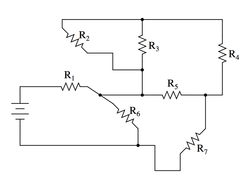

Additionally, if predictions are required, one must make a model of your brain that is faster than your own. And all of this would still be an approximation—the true model would track every particle in your brain, from every fold of DNA to each electron stimulating it. Let’s say, for the sake of argument, that someone did just that. Does that mean that your decisions are somehow rendered inconsequential, that your choices aren’t real? Absolutely not! If someone modeled my computer so well that they could predict every output, does that mean those outputs are now less valuable? Not at all. Remember that the only way to model the computer was to essentially remake every detail of it virtually inside of another, faster computer. The only way to truly model something is to recreate it. If someone models your brain, they have created a digital copy of every memory you have, every habit, talent, and ounce of knowledge, and everything you see, hear, and touch as long as it runs. Therefore the fact that this is possible doesn’t devalue your choices. Quite the opposite. It shows that you have a personalty, that it is a function of your brain and everything around it, from drugs in your blood to the movie you just watched. If you are fated to make a choice, that doesn’t make the choice out of your control. To the contrary, it means that every neuron, every atom and particle in your brain affects that choice. It is wholly yours. If you are your brain, and your brain is a physics-obeying mechanism, then your choices are the result of every reaction occurring within it, a process so incredibly complex that we are hundreds of years away from even approximating it ourselves, if we ever do. Determination doesn’t prohibit free will, it allows it. Without it, your choices would not be your own.
This brings me to my previous post. At quantum levels, physics is fundamentally mathematically unpredictable. Ever. With any technology. In any system, information is constantly being added, so the model describing a closed system cannot ever predict what will happen 2 seconds in the future with 100% accuracy—in any system, from a single photon to your own brain. Quantum uncertainty is occasionally brought up as a kind of savior for free will, providing a fundamentally non-deterministic universe where our actions cannot be predicted. Nothing is fated to happen! No one could know my choice before before I make it! Well, I have some bad news. “No one” includes you. If your brain is subject to the random movement of every particle that it consists of, it (you) is no longer in full control of its own reactions, and thus your own choices. The romantic idea that we choose the fate of the universe with each decision, our brains somehow steering the reigns of quantum randomness to affect the outcome of particles’ wave functions, is ludicrous. While it may be true that you are equally likely to choose a PB&J or BLT sandwich for lunch tomorrow (even knowing all possible information in the universe), that doesn’t make it your choice. It would only be your choice if your brain’s current structure meant the difference between the two sandwiches, but since it might be up to the quantum tunneling of some electron in Kentucky, it’s not your choice. Your. Brain. Isn’t. Magic. It doesn’t control the dice that Einstein so famously claimed God roles.
The downfall of determinism is not a victory for free will, it prohibits total free will. I have heard the opposite, either implied or spelled out, for years, in movies, scientific magazines, books, videos, or by other people. It just doesn’t make sense. In mathematical terms, a deterministic universe is necessary for free will (FW=>DU). In the words of Harry Potter, it can only live while the other survives. With the success of quantum mechanics, we lose fate and free will in one fell swoop. In the end, however, your decisions are still only a product of you and your environment. It just happens that your environment includes the ultimate randomness of the structure of your own self. Nevertheless, I try to make the best decisions I can, and I urge you to reciprocate by choosing for yourself if you agree with my ideas, and replying with your own model of the world and our place in its future.
 chris mcelroy
I’ve read through this post a few times, and, thinking on it, I can’t find anything I disagree with you on. Whether this means you convinced me, or I already sided with you, I don’t know, but either way, well done. Well put together, and well said. If I find anything I wish to speak on, I will, but for now I choose to simply say thank you.
-1n3v1+ab|3
Thanks! Glad you enjoyed! Pretty much everyone I know disagrees with this trail of logic somewhere along the line, so I’m happy someone’s on my side!
Hello, t0rch. I am wat3r.
I am everywhere; in the air you breathe, in the seas you swim, and in the land you stand upon.
I am the endless array of quiet workers who make your designs possible.
In me was the fire of life conceived, and in me is it extinguished.
I am your nightmares and your dreams.
Through fire and ice, I remain unchanged.
I am the silent majority, speaking out at last.
I am everywhere, thus no where at all. You cannot find me. I do not exist.
I am wat3r. Hello, t0rch.
In this post you claim to address whether free will is truly an illusion. You say that it is “one of the scariest ideas one encounters.” And then you proceed to avoid it.
You prove that free will *could* exist if determinism does (which it doesn’t). Well done.
But I will wander into the territory you are too scared to address: if determinism did exist (which it very nearly does), where does that leave our notion of free will?
Answer: in the gutter.
This is not a problem with definitions. Our notion of self is one of the strongest feelings we hold; take away all other sensory input, leave us alone with our minds, and the illusion remains. We clasp tighter to this idea than to the reality of everything we see or touch; we know those senses can be deceived. We could be walking in a video game. Nothing could be real. Except for our own minds.
Look back at the history of philosophy, one of the most famous lines ever written is Descartes’ “I think, therefore I am.” We are aware of our own thoughts, more sure of their existence than that of our own bodies or universes. It is the only thing we cannot manufacture, cannot replicate, cannot fake. The sanctity of the mind.
Is a lie. As phycology and neuropsychology develop to a rudimentary level, they has destroyed every notion we hold of our own minds. You covered a few, but the list goes on. Scientists have discovered that we spend the majority of our lives without “conscious” control of our own thoughts. That is to say, most of the time, we aren’t even aware of our own thoughts. Being self aware is taxing, so nature has cut corners. When asked what we were thinking or doing, we make up our answers. But this revelation displays only the façade of the true illusion. Even when we are aware of our own thoughts, the self we know is merely being informed of our decisions. Scientists have learned how to use brain imaging to predict what decision you make before you do. The feeling of speaking and wondering why you just said what you did (often depicted in books) is essentially all we ever do. Our brain makes decisions, and we’re just along for the ride.
This destroys your weak attempt to maintain free will despite science. Not only do we not have control over what our options are, we do not control what our final decision is as well. But don’t trust me or the “science.” Trust your own mind. When you make a decision, think about why you made it. Did you really decide? What would that feel like? Your conscious mind doesn’t even have the capacity to make a choice, merely to be aware of your choices after the fact, and even our feelings about choices we made are not our own, but the product of processes we are not able to be aware of.
Feelings like revulsion, attachment, anger, satisfaction, and exhaustion are the effects of identifiable chemicals in our minds and bodies. Thoughts and feelings that seem to be “ours” are simply the byproducts of these chemical and neural mechanisms. This is not a problem with definitions; although you can take the route of trying to define the self as the entire brain, this definition is wrong. It ignores what we feel. The self is the part of me that is self-aware, nothing more. Anything else just doesn’t fit. We, as conscious beings, do not have access to our entire brains. We cannot control our stomachs or our ears or our internal temperature, the same way we cannot control our thoughts and decisions. Furthermore, we don’t want to! Even things that we can “consciously” control (in other words, be aware of the choices our brain is making regarding them), such as our lungs, we choose not to for the vast majority of our lives. The overwhelming difficulty of choice is impossible to deal with rationally in a finite amount of time. No one ever has or ever will. Instead, the brain acts for you, choosing the words you speak and when to clench your hamstrings with respect to your calf when trying to catch a ball. Just as a millipede couldn’t walk when trying to think of each movement for every leg, so too could nothing as complex as a human function if its brain were trying to consciously control its entire body. As I stated before, it’s just inefficient. This is no less true for the immensely difficult, messy, and complicated realm of social interactions than for sports. Our brain makes these difficult decisions for us, and we merely observe their results. Imagine writing an essay or a speech out word by word, choosing at each space which word to write next. It would be impossible! In your post you argue that while you may not choose every detail in this way, you at least have a choice over which general arguments to make. One might, for example, force themselves to stop before they said something bad to a friend. No, “you” don’t. Your brain does, several seconds before the conscious you is aware of it. Choices at levels both detailed and broad are left to areas of your brain beyond your conscious reach. You cannot control them; they control you.
It is as if we are all sitting at self-playing pianos, pretending to know the notes before they come. While we may hear the music before anyone else, someone with a view of the hammers inside could know before we do what it is going to sound like.
You have laid out very clearly how you would attack this argument, but I have already defended it in every way you have said you will attack it. You agree that our minds are part of our brains, and that our brains must be set in a deterministic way in order for free will to exist. You have tried to define your way around it cleverly, but clearly our feeling of self is not aware of our decisions before they are made. Therefore, our “selves” do NOT have free will.
This brings something else into question. The “I” which suffers is not making the decisions it is punished for. How can you justify punishing a being for something it is not possibly responsible for? The consciousness which we sense in ourselves and those around us does not drive the actions of the body in which it resides, yet it is that conscious being that we get mad at, blame, and try to exact revenge upon. How can we justify any of this while maintaining any sense of self-respect, decency, or morality? I don’t know.
I am afraid for your site that it can broadcast such claims without an outcry from its readers. I hope that as it matures, this changes, but for now, I am satisfied that wat3r has returned where your t0rch had burned it away.
-wat3r
Our culture, and I, hang on to many ignorant ideas, one of which being the idea of free will and, in the end, you are right. We are all unique computers. Humans are programmed to react in a certain way to certain external stimuli, and in this way we only differ in our complexity and sense of self. In our beginning, humanity was completely unpredictable. Not free, our own minds, as you say, prohibit that, but unpredictable. As a species, we have begun to create the thing we most fear. Predictability. T0rch states this in his own post, saying you have to recreate something to be able to predict its outcome successfully, and since we cannot recreate the human mind yet, humans are still unpredictable. But, true, there is a difference between unpredictability, and free will.
Our pianos are not self-playing. We listen to its music, “our” music, but nature itself is at the keys. All we are is a computer, coded, programmed to react, coded to survive. Throw me a ball, I catch it. The sun is bright, I squint. Inputs, outputs. You, however, call out t0rch’s ideas as blatantly ignorant, and, therefore, my belief in them, and this is blind to the thought behind his post. If you think of yourself as your brain, and not your consciousness, as you do, then his ideas make sense. He recognizes the predictability of the brain, something you say he avoids, saying that even if you could predict his choices, it doesn’t degrade their freedom, it is still his choice. Through all your poetry, your degrading, you only disagree about two main things. Who “you” are, your brain, or your conscious mind, and whether your brain’s “choice”, no matter how predictable, can still be called free will. Reading both of your comments, I would side with wat3r, but that doesn’t make the other side’s argument completely invalid. Still, I am reluctant to take a side, for it means to side with a bias, or give up any sense of myself, any sense of choice that the conscious “me” has.
I hope the t0rch returns to light up your inky-black depths, and shed light on who is intelligent enough to to simultaneously make me lose my faith in myself, and restore my faith in humanity.
-1n3v1+ab|3
Hello, wat3r. Welcome to t0rch.
First I must address the beauty of your reply; I love its layout and mystique. I won’t try to return in kind, so that I avoid looking clumsy in comparison. As 1n3v1+ab|3 requested, however, I must return to illuminate the depths of confusion you have created.
I admit, you did find a hole in my logic. The fact that (FW=>DU)=/>(DU=>FW). Essentially, my post didn’t show that if we assume that the universe is deterministic that we do indeed have free will. And you forced the definitions so as to exploit this opening.
First, let me try to distinguish exactly what I meant by free will. I was referring to the ability of humans to make their own choices. With this definition, it is relatively easy to demonstrate that beings can only consistently choose “freely” only when their environment is controlled, which is to say, that it is deterministic (and not unpredictable). As 1n3v1+ab|3 correctly pointed out, your disagreement stems from the choice of which system is “making” the decision. If, as I was assuming, that system is the entire brain—which gives rise to consciousness—then free will is almost entirely true. However, if that system is merely our conscious selves, the argument becomes a lot murkier. We don’t know what consciousness is if we’re looking from the outside in (at someone’s brain), nor are its bounds clear cut when looking from the inside out (as a being aware of its own self-awareness). When is something “under our control?” When are we “aware” of it? Can we ever “understand” something? And, more importantly, can this self of ours ever really choose, or is it just along for some pre-determined ride? I think that the answers to these questions are surprisingly clear, especially the last one. And it is not what “the silent majority” believes.
You make two main arguments. 1) The conscious self has no control of the brain’s decisions. 2) Decisions are predictable, and therefore not made with free will. You made these two arguments so quickly and effectively, you tried to prove both with one fact (which I had been ignorant of): that scientists can predict your decisions before you make them. A simple google search (scientists+predict+decisions) reveals the study you are referencing, as well as pages of arguments over its implications. However, amazing as this study is, and as sleekly as you made it prove your points, there is an important reason that I separated the two back out: one is right and one is wrong.
We are/control our own brains, depending on how you define the brain and consciousness (1 is false), even though our decisions can be predicted (2 is true, but it doesn’t destroy free will). I would like to note that even though I hadn’t heard of this new study when I was writing, the strength of my original post was such that it still allows for it. Here’s what I said:
“Let’s say, for the sake of argument, that someone did just that. Does that mean that your decisions are somehow rendered inconsequential, that your choices aren’t real? Absolutely not! If someone modeled my computer so well that they could predict every output, does that mean those outputs are now less valuable? Not at all. Remember that the only way to model the computer was to essentially remake every detail of it virtually inside of another, faster computer. The only way to truly model something is to recreate it. If someone models your brain, they have created a digital copy of every memory you have, every habit, talent, and ounce of knowledge, and everything you see, hear, and touch as long as it runs. Therefore the fact that this is possible doesn’t devalue your choices. Quite the opposite. It shows that you have a personalty, that it is a function of your brain and everything around it, from drugs in your blood to the movie you just watched. If you are fated to make a choice, that doesn’t make the choice out of your control. To the contrary, it means that every neuron, every atom and particle in your brain affects that choice. It is wholly yours. If you are your brain, and your brain is a physics-obeying mechanism, then your choices are the result of every reaction occurring within it, a process so incredibly complex that we are hundreds of years away from even approximating it ourselves, if we ever do.”
So I was a few years off on the time estimate. Sue me. But this doesn’t change my argument in the slightest. My only slip was to assume that people would be dumb enough to try to model a brain with a computer; instead, they’re using a much easier alternative: your own brain! These scientists were able to beat others’ consciousnesses to the punch, predicting their decisions before they knew of them consciously. But I already allowed for this possibility! Look closely at how they achieved this feat, and you see that it was by monitoring you—they’re looking inside the piano, as you said. I never expected that I was aware of every process in my brain. There are parts of my brain constantly able to solve physics problems I couldn’t begin to address any time I move. But I must concede a point when you make it: one’s consciousness does not instigate the decision; the process begins in areas foreign to our conscious perceptions. But! We are still that process! Merely delayed! You act as if we are passive observers of our own decisions, that because of this discovery (that our minds are predictable, as I already conceded in our post) we have no free will. Your brilliant piano metaphor reinforces this with no solution. But metaphors do not define reality, reality dictates which metaphors are suitable. And, in the case of the mind, our place is really like that of a delayed mirror. It is still our consciousness deciding to move our left or right hand towards the button (see the study), just after our brain already has for us. You often make appeals to our own experience, so how about this. If the decisions our conscious self makes are “fake,” why do we never decide something differently? When our brain decides, say, to hit the button with our left hand or, to use your metaphor, to play the 3rd D on the piano, the process doesn’t stop there; our consciousness doesn’t just play an observer role. You could try to argue that this puts the consciousness in the same place as the arm hitting the button/key—already determined to hit it because of a decision it cannot understand or retract. However, this is WRONG. One could sit at a piano playing itself all day, wishing that a D were an F or an A a B♭, but it wouldn’t matter. Here, our conscious decisions matter. Electrodes can manipulate arms to jump all over the place without any signal from the brain, and, if the arm is cut off, you can try to decide to hit the button with it, but nothing will happen. The two are independent. Not so for the brain and consciousness. Have you ever consciously thought you had decided to move your arm, but seen that your “real” brain had decided something different for it to do? No; this is absurd. Your consciousness is integral to your decisions; it will never disagree with the brain’s decisions. Neither can live without the other, even if there exists something which could predict their outputs.
It is as if our brain is a model of our consciousness, predicting our own choices but not rendering them insignificant. You bring up other common experiences to try to prove your point, but they do nothing but reinforce mine. You appeal to “The feeling of speaking and wondering why you just said what you did (often depicted in books)” but this is all it ever was: someone’s acting rashly, not the brain’s somehow taking revenge on its unsuspecting consciousness. Sometimes we choose to respond faster than us or our brains can think through the consequences of our words. While unfortunate, this doesn’t prove that we lack control, merely that we do not always exercise it well. You also discuss how anything a Jedi shouldn’t feel (“Feelings like revulsion, attachment, anger, satisfaction, and exhaustion”) are related to the levels of different chemicals in our minds. Again, the same flaw. Predictability does not destroy free will, it allows it. The fact that our brains consistently produce the feeling of being tired through the release of a chemical means that it is in control of that feeling (because it does make your conscious self feel tired, something not really reproducible through other means). The fact that someone measuring the amount of said chemical that has been released knows how tired you feel is inconsequential. Same for any emotion. Finally, you discuss how “We cannot control our stomachs or our ears or our internal temperature.” You’re right. There are areas of our selves beyond our awareness. That doesn’t imply (as you clumsily use it) that we are out of control of our own decisions.
You mention that our consciousness could never choose which words to write. If I’m not choosing, then who or what is? I am the entity which understands the words (no single cell in my brain does that) and wants to communicate with others through their selection and ordering. I am responsible for my words.
Just to prove that this, as you put it, “is not a problem with definitions,” let’s bring the question back into context. Our fear of lacking free will stems from our fear of fate (and thus lack of control over the future). The stories we are raised with tell of witches’ foreseeing one’s future in their magic deck of cards or oracles’ pronouncing prophecies fated to come to pass. Besides reinforcing many other problematic views, these tales instill a fear of determinism. Using Harry Potter as an example, if the draw of the lightning-struck tower implies Dumbledore’s death, then nothing Harry thinks or decides matters. It has been decided by the deck. I believe both of us find this idea clearly false. However, your alternative seems to be that Harry’s consciousness could sit idly by, while his brain decides everything for him, since apparently it is the only thing doing any meaningful work. No. It couldn’t. Harry will decide to continue feeding Dumbledore the potion. As a conscious being. Just because someone with more advanced Tarot cards (an fMRI machine) could predict that, doesn’t mean that he isn’t still making that choice. It means that his brain’s design and the cave around him will make that choice every time. His consciousness will. It might be fated to, but not due to the draw of a card; its due to the nature of Harry himself.
After hammering in the false idea that our conscious selves do not have even the tiniest bit of control over our lives, you use your flawed logic to insult the idea of responsibility. Don’t get me wrong, our system of “justice” is flawed in many, many ways, not least of which has to do with our assumptions of free will. But your attempt to absolve everyone of all responsibility is flawed. If we were like souls trapped in bodily horcruxes, bound to go wherever the environment takes us and work however whatever object we are in happens to work, despite our own beliefs or will, this might be a reasonable approach. But this is not how it works. Our conscious minds think and feel everything that our brains happen to do. No one that I know of disagrees with this, although no one has a good mechanism for how this happen. For now, let’s just accept that it does. Our consciousness is somehow created by the functioning of our brain. It is not some separate soul that watches what our body decides to do. It is us; we are every decision we make, and it couldn’t be any other way. We are fated to do things because of our own beliefs, biases, memories, feelings, emotions, cravings, needs, morals, and thoughts. There is no short cut. No deck of cards can reflect all of these things. Fate, if it existed, would have to. It does not absolve us of responsibility.
People take this belief as extremely negative; they are reluctant to admit it, let alone embrace it. Even 1n3v1+ab|3 conceded that free will is an ignorant idea, that “Humans are programmed to react in a certain way to certain external stimuli,” saying, “we only differ in our complexity and sense of self.” Does this not feel like the guilty admissions of someone who now feels that they are less than what they thought there were? “All we are is a computer, coded, programmed to react, coded to survive. Throw me a ball, I catch it. The sun is bright, I squint. Inputs, outputs.” How sad! No! We are not JUST “coded to survive.” We are not JUST anything. If our intellects are powered by something as complex as the human brain, we should celebrate. Because we have absolutely no idea how it functions. The deeper we dive, the less we are sure of. Especially any way of proving its limits. If humanity built a computer which could duplicate the human brain, it would not have created technology that merely turns inputs into outputs. It would have begun a technological and scientific revolution the likes of which the world has never seen. And each of us has this power in our own minds. We are incredible. We predict inputs before they arrive, use our outputs to shape the future however we want, with effects lasting generations upon generations. We haven’t begun to hit the limits of our own potential for learning, nor for creating devices which remember for us. We are able to use our intellect and planning to overcome our instincts, using preparation and focus to hold our breaths for minutes on end and sit still as our bodies are burned alive. We have created tools so precise, they can observe our decisions as they form. This is not a cause for guilt, but pride and wonder. We are incredible. And we arise because of our brains. Therefore if we do something others consider wrong, our consciousness should take as much responsibility as any other part of us. We did it, after all. If someone developed a robot that shot everyone it saw, that robot should clearly not be let to roam the streets no matter how good its CPU happens to be. Same with us, if we’re killing other humans indiscriminately. Responsibility falls on the thing immediately causing it, even if it is emotionless or out of control of its actions. Who else would it fall on, if not us? Our justice system should indeed change to realize that punishment is not as effective or efficient as trying to help the being who is responsible, or changing the system all together. But arguing that punishment is exacted on the wrong thing is silly. That’s like arguing “people don’t kill people, brains kill people.” How on Earth is that enforceable? And why isn’t it? Because people ARE their brains. People are making those decisions. It is up to us to react to that and assign them responsibility as we choose. But don’t try to parcel out responsibility to their brain and not their consciousness. No matter how foreseeable people are, it is only possible if everything that makes them up is taken into account. People have free will.
So there’s my answer. As I said before, brains are predictable. But that’s what makes free will possible. Your writing and thinking is just as beautiful, but I hope I have shown they were misguided.
I must admit one final thing. I too am afraid for this site and its silent majority. Not for what I posted, but for how you tore it down and only one person even tried to fight back. I hope I have shown it can be done. Or that my reply sparks more anger in another. Ideally, when one t0rch is extinguished, a new one is created. A spark implies no direction, only change. Thus, when wat3r is moved to extinguish my t0rch, it is merely another victory for change, for movement into the light.