Sloth is a deadly sin. Those who cannot bring themselves to act, to do the hard work necessary for their own success, are rejected. We glorify those who are dedicated and hard working. I believe this misunderstands a central goal of the brain: to minimize energy expenditure.
When you’re doing a task, you want to do it with the minimum energy necessary to succeed. Any more than that is wasteful. If your goal is to run a race as fast as you can, putting energy into running faster is necessary for success. Putting energy into jumping on each step is a waste. Brains are incredibly good at discerning what is necessary, and finding a solution which does only that.
This is a good thing. This is what brains should be doing.
You do not want your brain, which is already using about 1/5 of your energy, to lead you to waste even more.
While this is a good thing, it can lead to negative outcomes like procrastination. Say I have an assignment due, which will be difficult to work on, that requires at least 2 hours to complete. If I took the time to engage with it and do my best work, it would take 4 hours. It’s due in 6 hours. What should I do right now? Well, the easier thing would be to not work on the assignment, since I have plenty of time to do it later. I’ve left starting now as an option, and my brain only wants to do what’s necessary. Even while I’m doing the assignment, I’ll find it much easier to get distracted by a text, or an email, or a friend asking to talk, and hard to turn away from that distraction and return to work. Not doing something difficult is much easier than doing something difficult. A state machine modeling this will spend much more time doing easy tasks than hard ones:
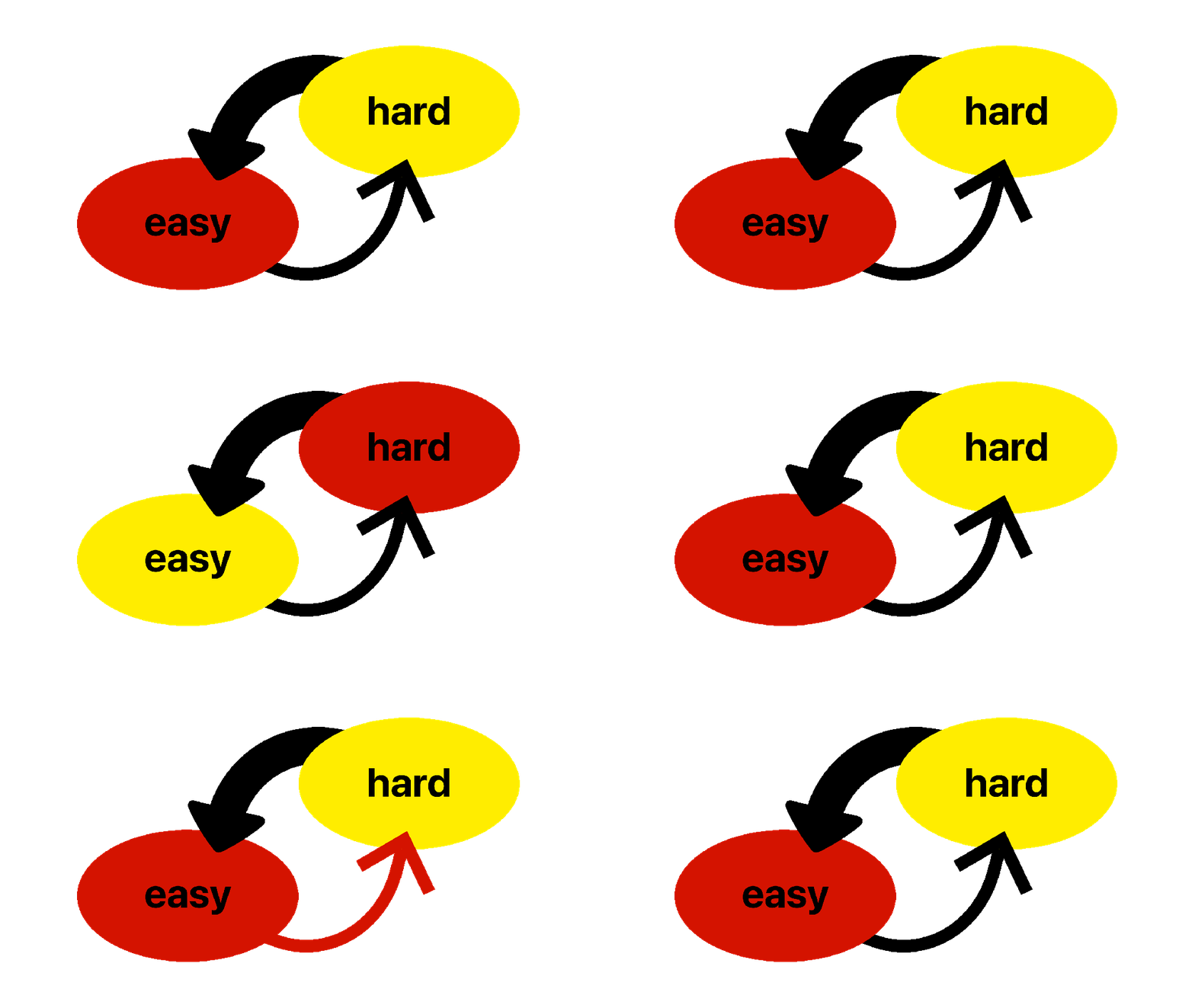
Now it’s 4 hours before the deadline. Should I start working now? No—I still have plenty of time. While I’d need to start working now to do my best work, doing so would be difficult, and there’s a much easier option available—not starting yet—which doesn’t preclude my finishing the assignment. Starting now is still optional. Obviously this logic only changes 2 hours before the deadline, when suddenly, avoiding the assignment is much harder than starting it. Avoiding the assignment at this point would mean reckoning with potentially failing to do it or submitting it late, both options that are much more difficult to confront than the assignment itself. So I begin to work.
This strategy, one that obviously leads to procrastination, does serve to minimize total energy expenditure. It also serves to prevent distractions, since starting at the very last minute means that any distraction would stop me from finishing the assignment. Two critical failures of this strategy are that it places extremely high trust in my time estimation (something I am not particularly good at) and it doesn’t allow me to do my best.
Nevertheless, identifying this strategy was extremely helpful, because I was already using it. I would find myself delaying work that I would obviously need to do later, or distracting myself from confronting difficult emotions. In the past, my best explanation was that I did these things because I was a bad person, and I resolved to be better. At one point I resolved to stop procrastinating entirely, and that helped relieve almost all my problems, until it suddenly stopped helping and I found myself back where I started. I had correctly identified the problem—procrastination—but I hadn’t understood the cause. My resolution, compelling while untarnished, lost all its power the first time it failed. I was trying to repress my badness instead of seeing its fundamentally helpful cause. A solution like “just work harder” or “love what you do” carries a similar naïveté; if what you do is hard, as many important things are, it will be hard to do it. Finding it difficult, or wanting a break, doesn’t make you broken. I didn’t see that. I thought I was broken. Understanding that my procrastination comes from my brain doing something helpful—minimizing difficulty—helped me be much more understanding and forgiving of myself, and helped me craft more robust solutions.
In the past I’ve tried working around my procrastination by signing up for enough things that the easiest route involves a lot of hard work. In the assignment example, this might look like taking on 3 of these assignments, forcing me to begin work immediately. Having done this in college, I did achieve more, but not with the quality or enjoyment I would have liked. Now 3 assignments have been done at the last minute, with the accompanying stress of doing so, and all of them have been done as fast as possible, prioritizing speed over care and learning. While this has generated more work, it has failed, I believe, to solve the core problem. I’ve relied even more on my time estimation, I still haven’t done my best on any assignment, and I haven’t learned as much as I could have, had I taken more time.
I think artificial constraints are a much more robust solution. If I’m struggling to start, I can split the assignment into chunks (with a required time to do each chunk), or require that I start 6 hours before the deadline. If I’m struggling with distraction, I could require that I do not chat with friends until I’m done, or that I work according to a pomodoro timer. If I’m struggling with accountability, I could require that I must work on it with peers, or that I have someone check on my progress regularly. Sometimes I find it’s enough just recognizing what’s going on; once I know that I’m only checking my email to avoid reading a paper, it’s harder to keep doing so. The key is to match the constraint to the situation and your place in it. Light tasks might need merely an encouraging thought, while difficult or emotional ones might require deliberate setup or the support of peers. To be effective, your constraint must make it harder to avoid the work than it is to do it. Such a constraint puts your brain back on your side: now the optimal path involves doing the work that you want to do, so you will do it.
For many years, I tried to avoid putting artificial constraints on myself. When I did use them I felt guilty and embarrassed; I was sad to find that I couldn’t work hard on my own. The constraints I added seemed unnatural, awkward, and overly stressful. It didn’t seem like the ideal solution. Over the years, however, I have gradually learned to make artificial constraints that are less awkward and cumbersome, and more robust and natural. Requiring that I get a certain amount of sleep every night ended up being much more awkward and limiting for me than requiring that I wake up at a certain time every day. Metering out how many minutes of youtube I could watch ended up being more stressful and indirect than measuring the time that I’m spending working. With these changes, I began to see that constraints could feel natural instead of cumbersome. However the added stress still gave me pause. Wouldn’t someone better than me just do the task, without adding extra constraints? I tried and failed to learn to do so myself. In retrospect, that failure was inevitable. I was trying to do difficult things. I was only going to do them once it was harder to avoid them. The stress of not-doing is not extra or additional, it is necessary for success. Adding constraints is not failure or weakness. Your brain avoids hardship. If the world—through your bosses, family, coworkers, deadlines, and public perception—is not providing enough, artificial constraints can and should provide the rest.
You want to do incredible things. Some of those things will be very hard. Without equally hard constraints, you will not do them.
 chris mcelroy